Connie Dixon—Blake McGrath relationship
The light house: A love storyThe Connie Dixon—Blake McGrath relationship is the novel’s central artistic and emotional bond. It joins Connie Dixon’s determination to recover a life as an artist with Blake McGrath’s withdrawal from painting after catastrophe, and it repeatedly tests whether love can be separated from possession, guilt, commerce, and grief. Connie first approaches Blake through his paintings, but their connection becomes transformative only when each recognizes the other’s concealed wound: Connie has been trapped by Duncan Cartwright’s exploitation, while Blake has made sorrow into the structure of his entire existence.
Identity and First Encounter
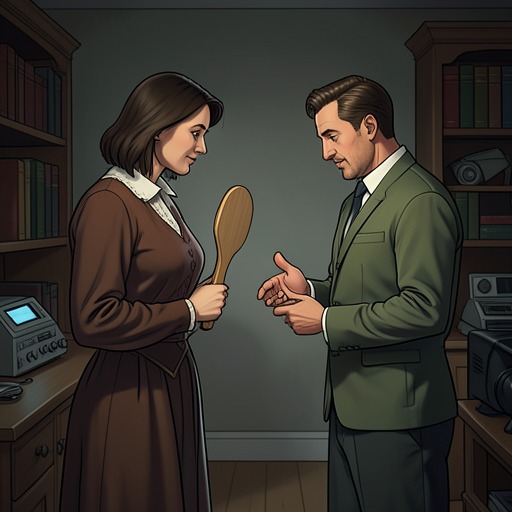
Connie Dixon enters the relationship as a gallery worker whose own artistic dream has been suppressed. Duncan Cartwright had promised exhibitions and recognition, encouraged her ambition, and then converted his financial support into leverage. Over four years, her dream of painting died beneath debt, sexual coercion, gallery labor, and threats involving her mother’s care. The relationship with Blake therefore begins against a sharply different model of intimacy: Connie has learned that apparent support may conceal ownership, while Blake has retreated from a public art world he once conquered.
Their first physical meeting is born from danger rather than courtship. After Connie’s car crashes on a storm-driven track while she is searching for the hidden house associated with Bill Mason’s paintings, she is injured, trapped, and unconscious in the mud. She wakes to the slobbering jaws of a Great Dane before a flashlight and a man’s voice identify her. Blake’s rescue places him first in the role of protector, but the scene also establishes the vulnerability that will govern their later exchanges: Connie arrives physically helpless, while Blake’s guarded identity and emotional history remain concealed.
The encounter becomes an artistic revelation when Blake tells Connie that Bill Mason is really Blake McGrath and then states plainly, “I’m Blake McGrath.” Connie already knows the truth, but hearing him claim it changes the relationship from investigation to direct recognition. She explains that she bought two paintings from Warren Ryan after finding a small painting in a Hoyt Harbor gallery, and that the work moved her to tears. Her interest is not initially reducible to commercial calculation. She says that she fell in love with the art and wanted to discover the person behind it, the force that had produced paintings she regarded as among the most beautiful of the modern world.
Art as Recognition and Shared Work
Blake and Connie connect most powerfully through the paintings. Blake explains that his works are a composite of what the camera saw and what the elements stirred in his heart. Connie understands the method rather than merely admiring the surface. She notices that his oil paint seems to melt into the canvas instead of accumulating into obvious texture, and her attention confirms that she can meet him within the technical and emotional logic of his art.
That recognition gives Connie a new role. Blake has kept the paintings wrapped, concealed, and absent from the world, while Connie sees their disappearance as a tragedy. She urges him to exhibit them, distinguishing public visibility from simple sale or profit. Her proposal challenges his cynicism about galleries: she wants the work shown even if it is not sold. In this exchange, professional purpose and emotional intimacy begin to overlap. Connie’s eye gives Blake evidence that the paintings can still communicate, while Blake’s body of work gives Connie a possible route back into the artistic life Duncan Cartwright had taken from her.
Their relationship also involves a transfer of confidence. Blake warns Connie not to repeat his mistake of sacrificing everything meaningful for the summit of a career. He urges her to remember the people she loves and not to let fate turn her choices into future regret. Connie answers not with a business argument but by embracing him and kissing him chastely. The gesture is grateful, intimate, and carefully restrained; it acknowledges that his advice has reached her as a person, not merely as an agent or art professional. After she leaves, Blake remains with the memory of the kiss, revealing that her presence has already begun to penetrate the isolation he presents as self-protection.
Return, Trust, and Emotional Disclosure
When Connie returns, Blake admits that he never expected to see her again. She repays the five hundred dollars he had loaned her, a small act that matters because it refuses to let their connection remain financially ambiguous. She then states her purpose directly: she wants to mount an exhibition of his old paintings and become his agent. Blake initially rejects the need for an agent, but Connie reframes the proposal around her own need for a client and her obligation to pursue the dream he had encouraged.
Connie insists that she wants to exhibit the paintings rather than sell them or profit from them. Blake, however, suspects that her return may be commercial, and he asks whether personal motives are involved. She acknowledges that she came back to see him. This admission shifts their relationship beyond shared artistic admiration. Blake has hoped that her return might be personal, yet he is unable to trust the hope. He looks away to hide the feeling she has stirred in him and asks for time to think.
His hesitation is not indifference. Walking sightlessly down to the sand with Ned, Blake recognizes that he has missed Connie and longed for her return, but he questions whether grief and loneliness have made him mistake emotional deprivation for love. He also feels guilty because his insistence on secrecy contributed to Connie’s loss of employment. Their bond consequently develops through competing impulses: Connie moves toward him with increasing candor, while Blake repeatedly withdraws because intimacy appears to threaten the defenses built around his grief.
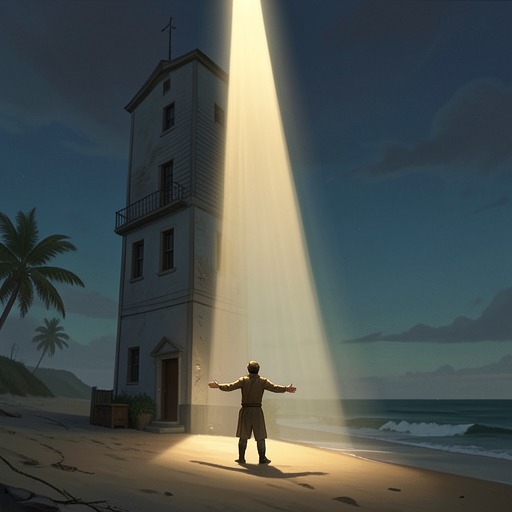
The deepest disclosure concerns Chloe. Connie understands that the young woman represented in Blake’s paintings was his lost muse, but Blake clarifies that his second great love was his daughter, Chloe, who died at six years old. She drowned on the beach five years earlier. The revelation explains his nightly return to the shore with Ned, the rose sent into the sea at sunset, and Ned’s waiting on the empty beach until morning. Blake also leaves the lights on in the light house so that Chloe might find her way home. Connie’s understanding of these rituals does not erase his grief, but it gives their relationship a language for it. She sees that the paintings, the beach, the dog, the rose, and the light are all parts of a continuing bond with the dead.
Exploitation, Conflict, and Choice
The relationship is threatened when Connie’s past becomes visible. Duncan Cartwright’s call exposes the secrecy surrounding the four years in which he used her sexually after making her financially dependent. Connie explains that she had moved to New York with little money and a desperate ambition to paint; Duncan discovered her, praised her talent, paid her bills, placed her in debt, and then demanded repayment through sex. Her confession is not simply background information. It explains why she has difficulty separating professional assistance from coercive control and why she must tell Blake the truth before their intimacy can become fully voluntary.
The disclosure initially appears to Blake as betrayal, but Connie’s account forces him to reconsider the silence he has interpreted as deception. She does not present herself as untouched by the past; she speaks through shame, pain, and memory while still insisting on honesty. Their conflict therefore becomes a test of whether Blake will reproduce the possessive logic that has already damaged Connie. His fear of being deceived and her fear of being judged meet in the same room, but the relationship survives because the hidden history is finally spoken rather than managed through concealment.
That movement toward truth reaches its harshest form when Blake tries to send Connie away. He tells her that she must be free to begin again and begs her not to remain out of pity. He fears that she will hear his grief in her voice or feel it whenever she looks at him, and he describes himself as a man who should be left to darkness. Connie refuses the terms of his self-condemnation. She distinguishes blindness from the emotional condition that has made him unavailable, telling him that his real problem is not being blind but allowing grief, misery, and self-pity to fill all the space where she might live.
The confrontation is significant because Connie does not promise to cure Blake or submit to his sorrow. She demands a choice from him, while Blake insists that his grief has become part of who he is. Their argument makes love an active negotiation rather than a rescue fantasy. Connie’s pursuit after he turns away demonstrates that she is choosing the relationship, but her words also require Blake to relinquish the idea that suffering grants him the right to decide for both of them.
Shared Future and Public Renewal
After the crisis of trust, the relationship becomes practical as well as passionate. Connie buys a new cell phone, contacts Jean and the nursing home, and begins organizing a life no longer governed by secrecy and coercion. Blake continues working in the studio, while Connie imagines a public studio in Hoyt Harbor, a shop on the main street near the grocery store. She maps the proposed space in the sand and infects Blake with her enthusiasm. The scene converts romance into shared planning: the future is no longer an abstract promise of fame but a place, a room, a working arrangement, and a community connection.
Connie’s professional ambition is also redefined through ethical action. When she learns the true value of the paintings, she returns to Warren Ryan and offers an additional forty thousand dollars after having paid three thousand for the pair. The payment distinguishes her from the exploitative gallery system that shaped her past. Her response to Blake’s art is not appropriation but restitution and stewardship. She seeks to make the paintings visible without turning their discovery into another act of possession.
The relationship culminates publicly at the opening of the Connie Dixon Gallery of Fine Art. Connie thanks the attendees, describes the opening as the completion of a dream, and welcomes the community to future exhibitions. She specifically credits Blake for allowing her to show his lost works and his new portrait, thereby linking his return to public art with her achievement of an independent professional identity. The applause places Blake at the center of a world from which he had withdrawn, while Connie’s speech makes their bond visible as collaboration rather than private dependency.
In its final form, the Connie Dixon—Blake McGrath relationship does not abolish the past. Chloe remains dead, Blake’s rituals retain their emotional force, and Connie’s history with Duncan Cartwright cannot be undone. What changes is the arrangement of those facts. Connie’s artistic dream becomes active again; Blake’s hidden paintings enter public life; the house and beach cease to be the only containers of his identity; and grief begins to share space with love, work, and community. Their relationship therefore functions as a reciprocal movement from possession toward consent, from concealment toward testimony, and from isolation toward a future made tangible through art.